
Independent ABCI Research Initiative

ABCI Iraq 2035

A Private-Sector Perspective on Iraq’s Next Decade

Iraq's next decade will not be defined only by oil prices or public expenditure.

Its long-term direction will depend on how effectively the country transforms its resources, population, capital and geographic position into productivity, businesses, employment and investment.

ABCI Iraq 2035 is an independent research framework examining the structural changes that could support a more diversified, productive and private-sector-driven Iraqi economy.

It is not a government strategy or official forecast.

Explore the Research
Research version 1.1Updated: 30 September 2026

A BASELINE FOR TRANSFORMATION

Iraq at a glance

Institutional baseline

Population

46.12M

2024 census · results published 2025

Total Iraqi and foreign population. Final results announced 26 November 2025. The statistical reference date must be consulted in the full census tables; the announcement does not specify it.

Definition, dates & source context
Measurement period
2024 census
Publication date
2025-11-26
Independent check
2026-09-30
Source edition
Linked publication / page; edition number not stated
Source: Ministry of Planning — 2024 census final results (published 2025) ↗
Derived from an official source

Non-oil share of real GDP

~47%

2025

Derived from the World Bank’s 2025 oil-share estimate: 100% − 53%. Approximate complement, not a separately reported official series.

Definition, dates & source context
Measurement period
2025
Publication date
Not identified in the linked source
Independent check
2026-09-30
Source edition
Linked publication / page; edition number not stated
Calculation
100% − 53% oil share of real GDP = approximately 47%; same 2025 estimate.
Source: World Bank — Iraq overview ↗
Institutional baseline

Unemployment

13.5%

Measurement period not identified in the linked source

World Bank Iraq overview; not a live estimate.

Definition, dates & source context
Measurement period
Not identified in the linked source
Publication date
Not identified in the linked source
Independent check
2026-09-30
Source edition
Linked publication / page; edition number not stated
Source: World Bank — Iraq overview ↗
Institutional baseline

Financial inclusion

~40%

Statement: February 2025 · survey period not stated

40% stated by the Central Bank on 26 February 2025. The announcement does not define the measured population, instrument coverage or survey period; comparisons require a consistent definition.

Definition, dates & source context
Measurement period
Not identified in the linked source
Publication date
2025-02-26
Independent check
2026-09-30
Source edition
Linked publication / page; edition number not stated
Source: Central Bank of Iraq — financial inclusion statement, February 2025 ↗
Institutional baseline

Electricity distribution losses

~55%

2024

IMF source context.

Definition, dates & source context
Measurement period
2024
Publication date
Not identified in the linked source
Independent check
Not reverified in this revision
Source edition
Linked publication / page; edition number not stated
Source: IMF — 2025 mission ↗
Explore the full data dashboard

Twelve pillars of transformation

01

Economic Diversification

Building a broader economic base beyond dependence on oil revenues, exports and public expenditure.

02

Private Sector, SMEs & Entrepreneurship

Turning small businesses and entrepreneurial activity into formal, productive and scalable companies.

03

Investment & Capital

Building a deeper capital ecosystem that connects viable opportunities with the appropriate form of finance.

04

Digital Economy & Artificial Intelligence

Moving from digital connectivity toward integrated data, digital productivity and responsible AI adoption.

05

Financial Transformation

Expanding meaningful financial participation through payments, banking, credit, insurance and fintech.

06

Energy & Sustainability

Turning Iraq’s energy resources into reliable, efficient and increasingly diversified power for the economy.

07

Healthcare Transformation

Connecting healthcare delivery, financing and data into a more integrated patient-centered system.

08

Education & Human Capital

Connecting education with skills, employability, productivity and innovation.

09

Industry & Local Production

Developing competitive local production where Iraq has market scale, resources or export potential.

10

Infrastructure, Cities & Logistics

Connecting transport, cities and logistics infrastructure to economic activity and regional trade.

11

Tourism & Cultural Economy

Turning Iraq’s religious, cultural, archaeological and natural assets into a broader visitor economy.

12

Governance & Institutional Capacity

Building institutions that can make decisions, coordinate implementation and measure outcomes more effectively.

2030 → 2035

Why 2030 Matters

ABCI Iraq 2035 does not treat 2035 as a distant endpoint.

By 2030, measurable evidence of structural change should already be visible across investment, energy, finance, digital government, industry, employment and institutional performance.

2030 is the execution test.
2035 is the direction of transformation.

An ABCI research assessment—not an annual government commitment.

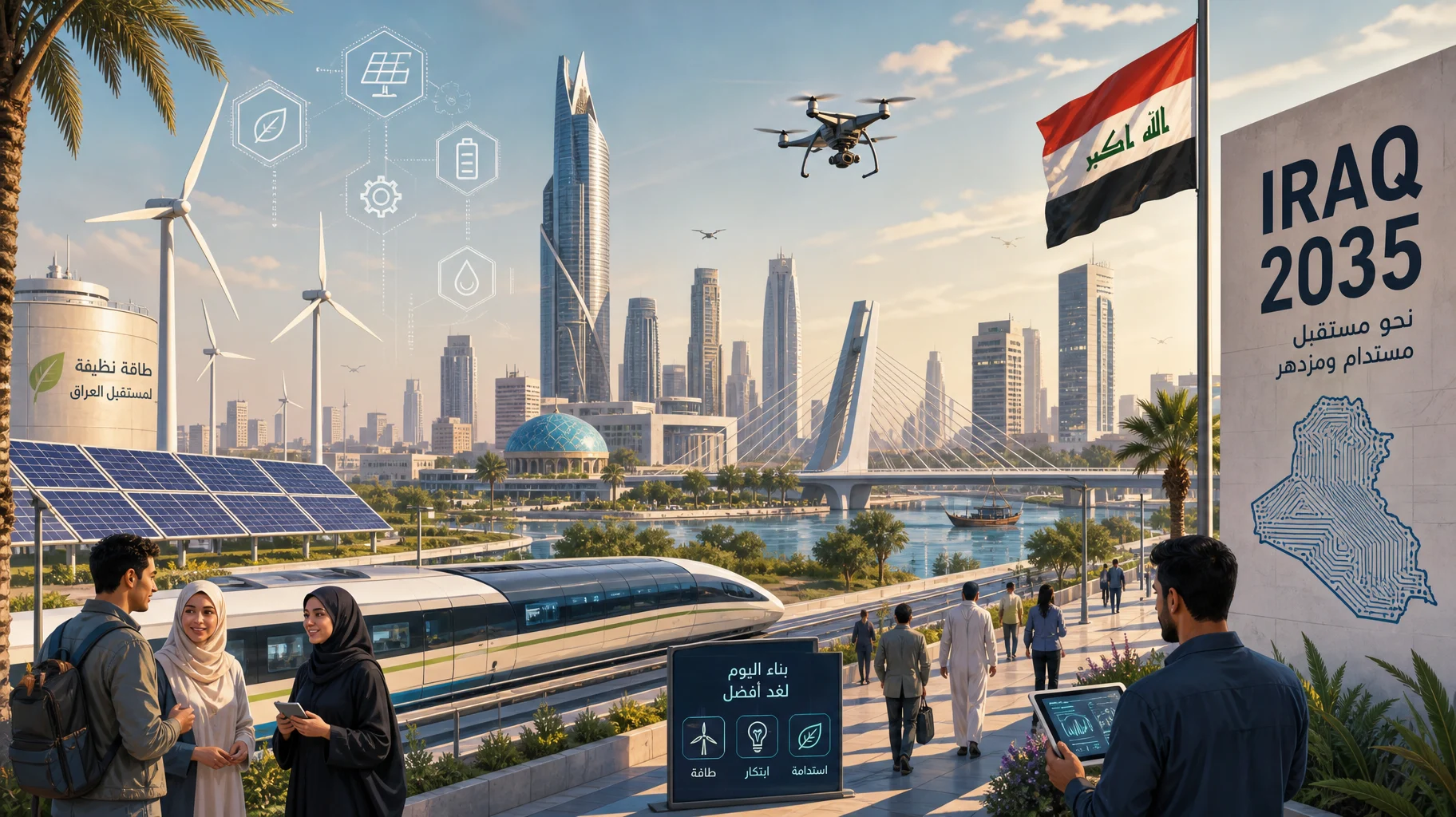
Concept illustration of a future Iraqi city with renewable energy, transport and digital infrastructure
Iraq 2035 — conceptual illustration. Not existing infrastructure or an official development plan.

Indicators, policies & directions

Use the dedicated dashboard to explore measures, policy periods and qualitative research propositions. Dates and classifications remain attached to each entry.

Open the data dashboard

METHODOLOGY VERSION 1.0 · SEPTEMBER 2026

Evidence before conclusions.

Each pillar connects a baseline and structural gap with interventions, an intermediate 2030 milestone and a longer-term 2035 direction. Official evidence and ABCI analysis remain distinct.

Read the methodology

ABCI · BAGHDAD, IRAQ

Let’s Build What Comes Next.

Whether you are developing a business, entering Iraq or evaluating an opportunity, start a conversation with ABCI.